Icinga-config
grundinstallation
config dir
- /etc/icinga

dateien
apache konfig datei
apache.conf
cgi konfig date
cgi.conf
kommando definitionen
commands.cfg
allgeimeine konfig datei
icinga.cfg
anbindung zur datebank
ido2db.cfg
plugins und eventhandler
resource.cfg
verzeichnisse
konfig verzeichnis für module
modules
erscheinungsbild der oberfläche
stylesheets
konfig verzeichnis allgemein
objects
kontakte
contacts_icinga.cfg
beispielweise debian png für debian host
extinfo_icinga.cfg
default einstellungen für rechner
generic-host_icinga.cfg
default einstellungen für services
generic-service_icinga.cfg
hostgruppen
hostgroups_icinga.cfg
ido2db
ido2db_check_proc.cfg
erste überwachungs datei hier localhost
localhost_icinga.cfg
definition der services
services_icinga.cfg
definition der zeitperiode
timeperiods_icinga.cfg
beginnen mit einem beispiel
der rechner wheezy
 define host{
        use                     generic-host
        host_name               wheezy
        address                 192.168.244.83
        }
plugins
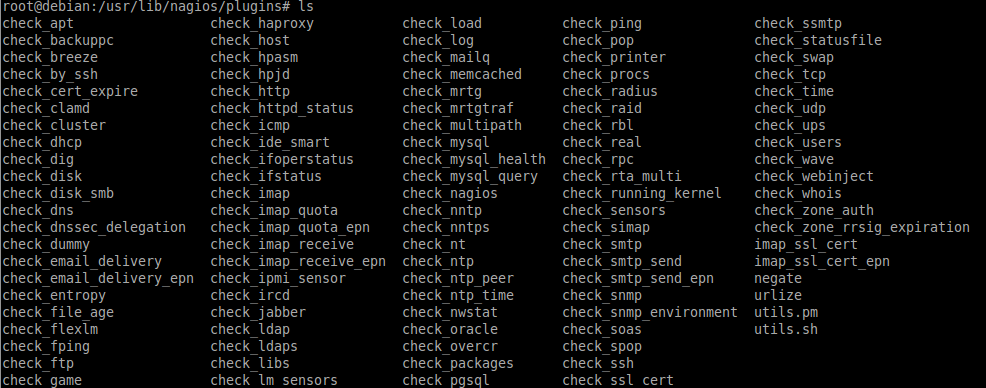

plugins liefern rückgabewerte
| Exit-Wert | Text | Bedeutung |
|---|---|---|
| 0 | OK | Alles im Grünen |
| 1 | WARNING | Serviceproblem |
| 2 | CRITICAL | Kritische Serverproblem |
| 3 | UNKNOWN | Problem mit dem Plugin |
plugin beispiel
plugin ausführen
./check_http -I 192.168.244.83
HTTP OK: HTTP/1.1 200 OK - 453 bytes in 0,001 second response time |time=0,001231s;;;0,000000 size=453B;;;0
rückgabewert checken
echo $?
0
weiter gehts
define host{
        use                     generic-host
        host_name               wheezy
        address                 192.168.244.83
        }


define command{
        command_name    check_myhttp
        command_line    $USER1$/check_http -I $HOSTNAME$
        }

define service{
        use generic-service
        service_description http_status
        host wheezy
        check_command check_myhttp
       }
vordefinierte komandos


beispiel check_http
http.cfg
define command{
        command_name    check_httpname
        command_line    /usr/lib/nagios/plugins/check_http -H '$HOSTNAME$' -I '$HOSTADDRESS$'
        }
unsere definition
define host{
        use                     generic-host
        host_name               wiki.local.xinux.org
        address                 192.168.244.83
        }

define service{
        use generic-service
        service_description http_wiki.local.xinux.org
        host wiki.local.xinux.org
        check_command check_httpname
       }
fremde rechner überwachen
auf dem client muss man einen nagios-nrpe-server installieren
apt-get install nagios-nrpe-server
haupt konfigurationsdatei
/etc/nagios/nrpe.cfg
log_facility=daemon
pid_file=/var/run/nagios/nrpe.pid
server_port=5666
nrpe_user=nagios
nrpe_group=nagios
allowed_hosts=127.0.0.1,192.168.244.90
dont_blame_nrpe=1
allow_bash_command_substitution=0
debug=0
command_timeout=60
connection_timeout=300
command[check_users]=/usr/lib/nagios/plugins/check_users -w 5 -c 10
command[check_load]=/usr/lib/nagios/plugins/check_load -w 15,10,5 -c 30,25,20
command[check_hda1]=/usr/lib/nagios/plugins/check_disk -w 20% -c 10% -p /dev/hda1
command[check_zombie_procs]=/usr/lib/nagios/plugins/check_procs -w 5 -c 10 -s Z
command[check_total_procs]=/usr/lib/nagios/plugins/check_procs -w 150 -c 200
include=/etc/nagios/nrpe_local.cfg
include_dir=/etc/nagios/nrpe.d/
nach der änderung neustart
service nagios-nrpe-server restart
wieder auf dem icinga server
install nagios-nrpe-plugin
apt-get install nagios-nrpe-plug
wegen faullheit :-)
echo 'PATH=$PATH:/usr/lib/nagios/plugins' > ~/.bashrc
source ~/.bashrc
erster check
check_nrpe -H wheezy
NRPE v2.15
beispiel check_load
check_nrpe -H wheezy -c check_load
OK - load average: 0.23, 0.35, 0.37|load1=0.230;15.000;30.000;0; load5=0.350;10.000;25.000;0; load15=0.370;5.000;20.000;0;
wir schauen uns /etc/nagios-plugins/config/check_nrpe an.
# this command runs a program $ARG1$ with arguments $ARG2$
define command {
        command_name    check_nrpe
        command_line    /usr/lib/nagios/plugins/check_nrpe -H $HOSTADDRESS$ -c $ARG1$ -a $ARG2$
}

# this command runs a program $ARG1$ with no arguments
define command {
        command_name    check_nrpe_1arg
        command_line    /usr/lib/nagios/plugins/check_nrpe -H $HOSTADDRESS$ -c $ARG1$
}
wir wählen das zweite wheezy.cfg
define service{
        use generic-service
        service_description check_load
        host wheezy
        check_command check_nrpe_1arg!check_load
       }
service icinga reload
gruppen bilden
define hostgroup {
        hostgroup_name          linux-generic-servers
        hostgroup_members       wheezy
        register        0
        }


define service {
        hostgroup_name                  linux-generic-servers
        service_description             disks
        check_command                   check_nrpe_1arg!check_all_disks
        use                             generic-service
        notification_interval           0 ; set > 0 if you want to be renotified
}

define service {
        hostgroup_name                  linux-generic-servers
        service_description             load
        check_command                   check_nrpe_1arg!check_load
        use                             generic-service
        notification_interval           0 ; set > 0 if you want to be renotified
}

define service {
        hostgroup_name                  linux-generic-servers
        service_description             users
        check_command                   check_nrpe_1arg!check_users
        use                             generic-service
        notification_interval           0 ; set > 0 if you want to be renotified
}

define service {
        hostgroup_name                  linux-generic-servers
        service_description             total-procs
        check_command                   check_nrpe_1arg!check_total_procs
        use                             generic-service
        notification_interval           0 ; set > 0 if you want to be renotified
}

define service {
        hostgroup_name                  linux-generic-servers
        service_description             check_nrpe_function
        check_command                   check_nrpe_function
        use                             generic-service
        notification_interval           0 ; set > 0 if you want to be renotified
}